RETABO Spring 2026
RETABO: Introduction to Japanese Film Spring 2026
Written for Introduction to Japanese Film, Spring 2026. Students were asked to write reviews of the Japanese films of their choice. During the semester, they reviewed films on film social media website Letterboxd, so the title of this website is a Japanese abbreviation of the term “letterbox”.
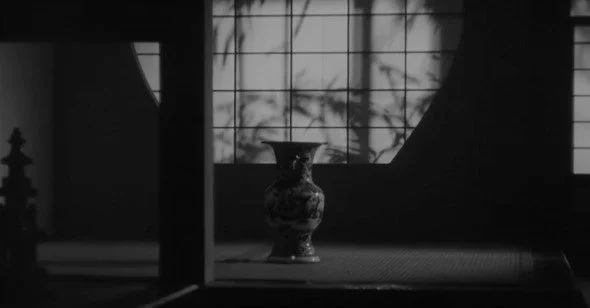
Late Spring and Emotional Incest: The “Shot of the Vase” and a Response to Hasumi Shigehiko
By Lizanna
Much has been said about the iconic “shot of the vase” in Ozu Yasujiro’s 1949 film Late Spring. As Hasumi Shigehiko recounts in the conclusion to his book, Directed by Yasujiro Ozu, both Anglophone and Japanese scholars alike have attempted to ascribe meaning and narrative purpose to this iconic scene, and Hasumi himself seems to contend that the vase is used to signify both the rejection of Noriko’s supposed sexual or romantic feelings for her father and the death of that desire, the death of the intimate bond between father and daughter.[1] Upon first encountering this reading of the shot, I found myself confounded by Hasumi’s analysis, as I had never considered Noriko’s character in Late Spring to have any sexual or romantic desire for her father in any capacity. In fact, I still do not believe this is the case. Instead, I argue that Hasumi’s argument should be flipped on its head—it is not Noriko who is perpetuating desire between her and her father, but rather Shukichi who has formed an emotionally incestuous relationship with his daughter. Using the “shot of the vase” as a jumping off point, this essay will examine themes of emotional incest in Yasujiro Ozu’s Late Spring.
Broadly speaking, emotional incest is a form of incest that does not involve direct sexual abuse, but rather a deep reliance of a parent on their child to fulfill certain emotional and even relational needs. This generally occurs when the parent is unable, whether out of will or ability, to rely on their partner to fulfill these needs, forcing their child to take on certain adult responsibilities in place of a spouse.[2] It should be noted that although this form of incest does not typically involve any sexual predation, it is no less abusive or inappropriate. Research has shown that parents who encroach on the parent-child boundary in this way may not intend to, and this behavior may even derive from certain cultural parenting norms.[3] Regardless, the impact of this abuse on the child can leave deep emotional scars that can impact their ability to function upon reaching adulthood.
Given this definition of emotional incest, I think it is clear that Noriko and Shukichi’s relationship in Late Spring could easily be read as one where the parent-child boundary has been slowly eroded away over time. Though it is not made clear exactly when Noriko’s mother died, the film’s first few opening scenes make it apparent that she has not been alive for some time—at the tea ceremony, Noriko’s aunt gives her trousers to mend and tailor for her father, a task that does not seem unfamiliar to Noriko at all, and a task that likely would fall to a wife before a daughter. When she returns home, Shukichi asks his daughter where her aunt is and upon learning that she did not come over with Noriko, he asks her to put on tea for him and his assistant; that he inquires about her aunt might imply that had she been there, Shukichi may have asked her to make the tea rather than Noriko—a task that, as in many Ozu films, is generally taken on by the spouse rather than the child. Noriko even has to reign in her father’s antics as he tries to ask her to see if a neighbor is interested in playing a hand of mahjong; Noriko tells him that he cannot play as he still has not completed his overdue manuscript. All of these minor events happen within the first 10 minutes of Late Spring, and nearly all of them meet some aspect of the Childhood Emotional Incest Scale (CEIS).
Throughout Late Spring, Noriko is shown attending to various needs of her father, such as helping him dress, reminding him of meetings, and cooking his meals. Though Shukichi is the primary adult male figure that Noriko interacts with, she does meet with one of her father’s friends, Professor Onodera, on several occasions. Like Shukichi, Onodera’s first wife also passed away; unlike him, however, Onodera remarried, something that the apparently traditionally-minded Noriko finds objectionable and even repulsive. It would be easy to argue that her discomfort regarding remarriage, especially upon learning her father “intends” to follow in Onodera’s footsteps, is related to her father in a jealous way, perhaps not even on her own behalf, but potentially on behalf of her deceased mother. Perhaps Noriko is simply disgusted by how men seem to be able to move on easily from the loss of a loved one (after all, the Noriko that is in another infamous Ozu film, Tokyo Story, and is also played by Hara Setsuko refuses to remarry years after the loss of her husband in the Pacific War). Based on her reaction, however, to her father’s “rejection” of her desire for her life to remain the same/his desire for her to marry during the vase scene, I think it is more likely that the concept of no longer caring for her father as a daughter/wife feels wholly destabilizing. Almost all the things Noriko does throughout the film relate to her father in some way—it is therefore likely that her personal identity and self-worth have been internally tied to her ability to support her father, possibly for decades at this point. Once married, her father will no longer be her “head of household,” and therefore she will no longer have any obligation of care. Essentially, the marriage that Noriko enters at the end of Late Spring requires the death of the Noriko that is Shukichi’s daughter/wife—everything she knew will no longer be accessible in the same way.
To be sure, I do not think that Shukichi intended to blur the boundary between father and daughter, nor do I believe he feels any romantic or sexual attraction for his daughter. As mentioned before, however, emotional incest can be impacted by cultural parenting norms and broader systemic notions of propriety for the family. During the Tokugawa period, efforts were made to restructure the social and political fabric of Japan, which resulted in the neo-Confucian treatment of the household as not only the basic building block of society but also as a sort of microcosmic reflection of the shogunate itself.[4] The relationship between husband and wife, father and child, and ruler and subject were thought to be reflections of each other, thereby connecting the individual to the family, and the family to the state. Even as Japan began to industrialize and annex surrounding territories, the notion of the family as the fundamental component of the state would lead to the creation of the Meiji ideal, “good wife, wise mother,” and later, during the Pacific War, the notion of “motherhood for the nation.” These ideals subordinated mothers (and daughters) both to the male head of house and to the state and despite their prescriptive (as opposed to descriptive) nature, they would continue to impact the idealized norms for Japanese women for decades.[5] This is all to say that the social environment that Noriko was raised in essentially idealized a certain form of emotional incest: that daughters should be raised to be wives and then mothers, and that before marriage, they effectively honed those homemaking skills under their fathers—all for the supposed purpose of strengthening the nation. I believe this context is crucial to understanding Noriko’s feelings about her father as well as the infamous “shot of the vase.”
Truthfully, the “shot of the vase” is poor shorthand for the scenes that scholars, including Hasumi, and I seek to ascribe meaning to. On its own, the shot has no meaning. Really, what has captivated academic interest is a roughly three minute scene (longer, if you include their conversation the following day) involving Noriko and Shukichi towards the end of Late Spring. The father and daughter sit next to each other on their respective futon after a day of sightseeing in Kyoto, where they are vacationing prior to Noriko’s marriage; Noriko at first appears to be happy, almost dreamily so. The expression the Hara Setsuko wears during the first half of this sequence could almost, as Hasumi seems to, be viewed as flirtatious or coquettish, especially given the context that this sort of sleeping arrangement (a parent and child of different sex sleeping in one room) is rare in Ozu’s films. Noriko turns off the light so that the two can sleep, which allows light from outside the paper screens to gently cast the shadows of bamboo across the faces of Noriko and Shukichi. Before sleeping, Noriko admits that her disgust at Onodera’s remarriage was stated in haste, and that she feels much more warmly towards Onodera after finding his new bride to be a kind woman. That expression that seemed so sweet and demure at the beginning of the scene begins to feel more and more forced; Noriko appears strained in her efforts to maintain her composure. Slowly, her smile fades and her father appears to fall asleep; Noriko seems to be lost in thought, which is when the first cut to the vase occurs. It is notable that she cannot be looking at the vase, as the earlier shots of the bedroom showed that it was actually behind where both Noriko and Shukichi are sleeping. We are then shown Noriko’s increasingly sad expression and the vase again in quick succession, and the scene ends. What could this sequence, outside of what words are spoken, seek to convey to the audience?
Hasumi posits that the vase is somewhat of a stand-in for the father; by falling asleep, whether he is faking it or not, Shukichi seems to reject Noriko’s love, jealousy, and sadness, becoming a part of the decor in the moment and mirroring the background role he will play in her life going forward.[6] Though I do not entirely disagree, I feel that this reading places the cause for Noriko and Shukichi’s odd father-daughter/wife relationship entirely on Noriko; Hasumi almost seems to blame her for whatever sexually/romantically complex feelings she has towards her father. If the vase does represent Shukichi, it is more effective in reflecting the loneliness he displays after sending Noriko off in the final scene of the film. A better symbolic reading, in my opinion, would be of the vase as a stand-in for an urn. After all, in the approximately 18 minutes of the film that follow the final shot of the vase, Noriko and Shukichi both experience a death of the self that existed before, and will both need to remake themselves in the other’s absence. Perhaps more grimly, it could represent Shukichi as being towards the end of his life, about to finally fulfill his final parental duty to see that Noriko settles into a new household. Ultimately, though, I think the vase itself has no intended meaning; the framing of the shot, however, creates this intense atmosphere of loneliness, a loneliness that the audience naturally seeks to understand.
In the following scene, where Noriko and her father pack their suitcases to return home, I believe Ozu attempts to understand that loneliness for us. Most of Noriko’s relationships shown to the audience in Late Spring are primarily facilitated through her father in some way; be it her friendship with Shukichi’s assistant, Hattori; her apparent closeness and trust in her father’s friend, Mr. Onodera; even her aunt is Shukichi’s sister and therefore not related to her mother by blood. Noriko spends much of her time on errands with or for her father. Is it any wonder that she so desperately wants things to remain the same? Noriko was likely raised to be a “good wife” and “wise mother,” a role she was somewhat forced (not directly, but rather out of love and care) into in order to care for her father. Once married, she will have to somehow translate her current life into something compatible with her new husband’s social station and circle. She will have to adapt to her new husband’s tastes, preferences, behaviors, and customs while unlearning (or killing the Noriko who attended to) those of her father. Even though Shukichi likely did not intend to create such a deep dependence on his daughter, nor for her to feel so intensely about him, the contemporary Japanese social environment and the cultural norms that Shukichi apparently seeks to uphold made Noriko’s feelings an inevitability. Her intense sadness and fear (which she tries unsuccessfully to mask) regarding her new life that Noriko displays on the day of her wedding are a result of the societal pressures not simply to marry, but also those that taught her to care for her father not only as a daughter, but also as a wife.
The reading of Noriko and Shukichi’s relationship as emotionally incestuous, for me, allows the viewer to understand not only what Ozu is trying to say as the director for Late Spring, but in his films more broadly. While his protagonists do not generally seek an upheaval of the social norms that harm them, Ozu seems to have been fixated on exploring how society seeps into the family and into the self. I would argue that Ozu even hoped that his audience would question why we do things that hurt us personally and our loved ones more generally in service of conforming to some idealized prescriptive norm. Do we gain anything? Do we make society run more smoothly? Should we sacrifice our own desires in the service of society, especially in a society that rapidly shifts and changes what norms are acceptable or not? Ozu does not have any prescription or solution for this dilemma, especially not in Late Spring. Perhaps, then, it is up to all of us, both individually and collectively, to continue to actively shape and re-shape society to meet our needs. Perhaps there is another world where Noriko is free to marry or not, free to live with Shukichi or not, or even free to do both, regardless of what is “normal” or not. Until we discover that reality, Late Spring’s Noriko will seemingly be at the mercy of both family and society, a predicament she shares with Ozu’s other Norikos and protagonists, and maybe a fate that we share as the audience, too.
[1] Hasumi Shigehiko, “Conclusion: Pleasure and Cruelty,” in Directed by Yasujiro Ozu (University of California Press, 2024), 293-294.
[2] Elif Çimşir and Ramazan Akdoğan, “Childhood Emotional Incest Scale (CEIS): Development, Validation, Cross-Validation, and Reliability, Journal of Counseling Psychology 68 no.1 (2021): 98.
[3] Çimşir and Akdoğan, “Childhood Emotional Incest Scale,” 99.
[4] Amy Stanley, Selling Women: Prostitution, Markets, and the Household in Early Modern Japan, 54
[5] Amy Stanley, “Enlightenment Geisha: The Sex Trade, Education, and Feminine Ideals in Early Meiji Japan,” in Journal of Asian Studies 72 no. 3 (2013): 540-541; Hillary Maxson, “From ‘Motherhood in the Interest of the State’ to Motherhood in the Interest of Mothers: Rethinking the First Mothers’ Conference,” in Rethinking Japanese Feminisms ed. Julia C. Bullock, Ayako Ayano, and James Welker (University of Hawai’i Press, 2017), 35-36.
[6] Hasumi, “Conclusion,” 291-292.
Look Back
By Andrew
A Japanese movie I will review and want to share is Look Back. Look Back is a Japanese animated coming-of-age drama film based on the one-shot web manga of the same name by Fujimoto Tatsuki.
This film traces why Fujino draws manga. At first, she discovers her love of drawing through the dopamine rush of being a minor celebrity as the star manga artist at her suburban elementary school. Then, she becomes obsessed with manga to beat her rival, Kyomoto. Later, she draws manga to satisfy her biggest fan, Kyomoto, and eventually to create manga together with her as a partner.
Throughout the film, many characters—and even Fujino herself—repeatedly ask the same question: “Then why do you draw manga, Fujino?” This question becomes one of the film’s central themes. It isn’t limited to why manga artists draw manga. It expands into a broader question directed at the audience—why we do what we do, why we love who we love, why we keep waking up every day, and why any of it matters. Sometimes we don’t have an answer; we just do things because our heart tells us to or because it simply feels right. The same is true for Fujino when she is asked why she draws manga. She also does not have a clear answer to the question and struggles with it, even suffering because of it throughout the film.
Then the film goes in a completely different direction and shatters the audience’s hearts. It makes us regret every time we left things unsaid and even question our entire lives, if only a little. In doing so, Look Back encourages the audience to remember the joyful moments instead of looking back in regret—constantly replaying situations and wishing things had gone differently. Memento mori. Appreciate every moment you spend with the people you love.
In the film, “look back” is not limited to the meaning of reminiscing. It can also be interpreted through the Japanese idiom 「背中を見て育つ」, which suggests that people grow by watching and learning from the actions of others. Personally, I found this perspective particularly interesting when comparing reviews from Western audiences and East Asian audiences.
Reviews on platforms such as IMDb, Letterboxd, and Rotten Tomatoes tend to interpret “look back” primarily as reminiscing or recalling good memories. In contrast, reviews on Naver and Yahoo Japan tend to interpret “look back” through the lens of the idiom 「背中を見て育つ」. Some even go further, reading the phrase more literally as “looking at someone’s back.” When I watched the film in the theater, I also interpreted it as “looking at someone’s back,” since Kyomoto always followed Fujino and watched Fujino’s back throughout the entire movie.
Also, a notable point found in Yahoo Japan reviews—but not in Western audience reviews—is the Kyoto Animation arson attack. People who give low scores to Look Back on Yahoo Japan mainly refer to this incident and say they feel uncomfortable because of it. The release date of Look Back coincides with the second anniversary of the attack, and it also includes a reference to Once Upon a Time in Hollywood at the end. Considering these points, it seems that Fujimoto Tatsuki and Oshiyama Kiyotaka may have included these elements to pay their respects to the victims of the Kyoto Animation arson attack.
These difference in interpretation reminds me of the Rashomon effect that I learned about in my Japanese film class and feels how cultural context shapes film reception.
The running time of Look Back is less than an hour, at 58 minutes. This short running time may be because it is based on a one-shot web manga. However, I believe it is also an intentional choice that reflects the era of short-form content.
This short running time might make some audiences feel that the movie is not worth the ticket price, and some audiences say they cannot attach to the characters in an hour or less.
However, I strongly believe that this short running time is one of the main factors behind the movie’s success. Director Oshiyama Kiyotaka does not rush the story despite the film’s 58-minute runtime. Instead, he focuses on the most significant moments of Fujino and Kyomoto's story, presenting a beautiful and perfectly paced 58 minutes.
Look Back packs a lot of emotion into just a little over fifty-six minutes of visual storytelling. It encompasses years, much of it spent hunched over a drawing table, with the seasons changing around these characters and the days just melting away as they throw themselves into their work. Therefore, the audience gets into the narrative of these characters within a short period of time.
Plus, the film does nothing to make creating manga look glamorous; instead, it shows the frustration, tedium, and stagnation behind the process. This reminds me of how people sometimes focus entirely on one thing and pour everything they have into it. I believe everyone experiences such a moment at some point in their lives, and it helps us understand why that moment can feel so deeply satisfying.
If I pick my favorite scene in this film, I will choose the one where Fujino is walking in the rain. Her stride becomes a little bigger, and then we cut to her skipping, the rain continuing to fall. She starts kicking up water, continuing to make herself bigger in a world where she has felt so very small. The other favorite scene in this movie is the ending. During the ending credits, a long take shot shows Fujino drawing a manga, which reminds all the people who endure their sadness and continue living their everyday lives.
Look Back shows the characters’ emotions visually. In this film, each character isn’t very good at saying what they’re feeling. A lot of things go unsaid, but they are delivered through a series of images visually. Understanding that your work has affected somebody—whether in small ways or in a profound manner—doesn’t need to be said out loud.
The atmosphere in the movie, created by the soundtrack along with the heartfelt performances of the voice actors, enriches the narrative and makes it even more profound. It is no exaggeration to say that the movie's rhythm and the way it influences the audience's emotions are perfectly shaped by the soundtrack. Nakamura Haruka's soundtrack is amazing, especially the main theme Light Song.
Following the success of the animated coming-of-age drama film adaptation, a live-action adaptation produced by Kore-eda Hirokazu is scheduled for release in 2026. Although detailed information about the film has not yet been revealed, I am looking forward to seeing how it turns out.
Beyond “Fanatic Yelling”: Why Social Change Needs Both Yuta and Kou
By Yae-na
“You think fanatic yelling on the street can actually change anything?” Yuta retorts to Kou in Happyend. Neo Sora’s 2024 film Happyend initially appears to be an immature coming-of-age story, featuring teenage antics such as tipping the principal’s yellow sports car upright or sneaking into a techno club. Yet the film raises deeper political questions. According to Sora, the original script even included a large-scale protest scene.[1]
Set in a near-future Tokyo, the film follows a group of high school friends led by Yuta, a Japanese student from a relatively well-off family, and Kou, a fourth-generation Zainichi Korean whose mother runs a restaurant. The group also includes Ata-chan, who offers comic relief, Ming, a Taiwanese-Japanese student, and Tom, whose father is African American. Yuta dreams of continuing to make music and spend time with his friends after graduation. Yet this vision begins to falter as Tom plans to move to the United States and Kou grows closer to Fukuko, a classmate involved in anti-government protests.
While Yuta wishes to enjoy the present, Kou becomes increasingly politically conscious. The two characters have often been read in contrast to one another. In the final scene, they part ways on the pedestrian overpass they usually cross after school, walking in opposite directions, which many interpret as signaling the end of their friendship.[2] Certainly, the film emphasizes their conflict. In one scene, during an argument between the two, a flickering light casts their contrasting silhouettes: Yuta fiddles with a music device while Kou stands upright, confronting him. (Fig. 1) However, the ending is open to another reading. It suggests that social change requires both figures, offering a hint to the film’s central question: how can society be changed?
At first, Yuta may appear apolitical, since much of the story unfolds from Kou’s critical perspective. However, when he shouts, “The world is already over. Face reality! If you lower your expectations, you’d have more fun in life,” his attitude seems closer to cynical resignation than to a lack of political concern. Later, at a decisive moment, when the principal promises to remove the AI-based disciplinary system only if the student who committed the “terrorist act” against his car comes forward, Yuta claims responsibility. Was this simply an act of friendship? Also, if Yuta’s decision was brave, does that make Kou, who has consistently challenged the school’s system of control, cowardly? Such a simple judgment is difficult to make.
From the opening scene, in which the boys are caught at a techno club, to a later moment when they are stopped by the police while moving their equipment with the music playing, discrimination against Kou recurs. Each time, Yuta is let go relatively easily, while Kou is treated more harshly, asked to show his residency card, and subjected to closer scrutiny. As a Zainichi Korean, he has the strongest reason to speak out. However, because of his family’s financial situation, he must secure a university scholarship and cannot risk falling out of favor with the principal. On the other hand, Yuta, who comes from a more privileged background, has little reason to do so. Yet he repeatedly witnesses the discrimination faced by his best friend. Thus, Kou is the one who continually raises questions about the system, while Yuta has the freedom to speak from a more secure position.
The school’s AI disciplinary system, which Kou and other students seek to abolish, parallels how governments justify expanded control by invoking external disasters, such as earthquakes. Although the technology appears objective and efficient, the film humorously reveals its flaws. When Kou and Yuta are smoking, another student takes the cigarette from them to stop them, yet the system penalizes him instead. One of the most visually striking moments appears during a Self-Defense Force informational session at the school. Only “pure” Japanese students are allowed to remain in the classroom, while the multicultural students are asked to wait outside in the hallway. As they stand there, they collectively stare at the surveillance camera. Orange squares immediately frame their faces, each marked with a numerical ID, as if labeling them within the system, almost as though their very presence were being registered as an error. (Fig. 2)
Ultimately, the school’s AI disciplinary system is removed through their actions. Although the removal of a single system does not eliminate systemic discrimination, Happyend suggests the possibility of change through the interaction of people occupying different structural positions. In the final scene, the two walk together across the overpass, reflecting the path they have shared as friends. While the AI’s overhead gaze fragments their faces into orange frames of data, the film’s eye-level perspective on the pedestrian overpass places us at their eye level. (Fig. 3) This horizontal composition contrasts with the system’s vertical surveillance, reconnecting fragmented individuals back into a collective momentum. Although they walk in opposite directions, their paths will intersect once they descend to the ground, if not now, then eventually.
Happyend. According to Sora, “happy” evokes youthful energy, while “end” captures apocalypse or collapse.[3] It signals the end of their high school life, yet paradoxically invites us to think about another beginning, much like when Kou asks his teacher, “What comes after?” In a way, this new start extends beyond the film itself. Many of the cast members are first-time actors, and this film also marks Sora’s first feature. The actors who played Yuta and Kou became close friends during filming and now live together as roommates.[4] Moreover, the illegal techno club scene that opens the film features a cameo by real-life DJ Yusuke Yukimatsu, performing tracks such as “AAA – A Thing” and “Beholden – Sandy’s Trace.” (Fig. 4) Following a 2016 brain cancer diagnosis, he left construction work and began what could be seen as a second life as a DJ.[5]
In this sense, the title “Happy End” suggests not a conventional closed resolution but an openness to transformation. Like Kou and Yuta, the characters never settle into a single, fixed position, whether in their political attitudes, friendships, or life direction. Their instability becomes the very condition of possibility. The film allows the audience to experience this instability bodily through two elements: earthquakes and techno music. Strikingly, the earthquake scenes are rendered in complete silence, while the heavy bass of the techno soundtrack makes the vibration almost physically perceptible. Rather than simply watching the film, the audience is made to feel this instability and, for a moment, inhabit the same unstable world.
[1] Naman Ramachandran, “Neo Sora Talks Political Divide in ‘Happyend’: ‘Japan Hasn’t Really Reflected on its Colonial Past’,” Variety, March 14, 2025, https://variety.com/2025/film/news/neo-sora-happyend-interview-1236338227.
[2] Ramachandran, “Political Divide.”
[3] Maja Korbecka, “Folding Different Temporalities: An Interview with Neo Sora,” Senses of Cinema, no. 114 (July 2025), accessed March 13, 2026, https://sensesofcinema.com/2025/issue-114/folding-different-temporalities-an-interview-with-neo-sora.
[4] Korbecka, “Folding Different Temporalities.”
[5] Gabriel Szatan, “¥ØU$UK€ ¥UK1MAT$U: Firestarter,” Resident Advisor, June 17, 2025, accessed March 13, 2026, https://ra.co/features/4447.
Tampopo
A review of one of the goofiest, horniest, and most original films of all time.
By Trey
Tampopo begins with a warning. A swaggering gangster and his beautiful partner sit down in the first row of a movie theater, as their goons prepare a buffet in front of them. Framed directly in the center of the screen, he sports an old-fashioned, white, three-piece suit with a fedora, and she wears a matching white dress with rockstar-like hot pink eyeshadow. Nobody has ever looked cooler. When someone begins crinkling a bag of Curry-flavored potato chips in the row behind them, the gangster gets up and calmly notifies him that if he makes that noise when the movie starts, he will kill him. The threat is intended just as much for the audience as it is for the unfortunate chip-eater. Food is deathly serious, and should be treated as such. The audience is now hooked to spend the next two hours following this fascinating couple, so Tampopo shifts away from them and into a completely different narrative.
This is not the only time Tampopo, written and directed by Juzo Itami and released in 1985, will misdirect its audience. In fact, Tampopo is deadset on defying the typical tropes we use to foretell stories, delighting in its own ridiculousness instead. It is a spaghetti western, a comedy, a romance, a sports drama, a satire, and an occasional gangster noir, yet it finds a way to detach itself from each one of these labels with every passing scene. This is partly due to its non-traditional narrative structure, reminiscent of Japanese Kabuki theater. There is one central storyline about a widow named Tampopo running a ramen shop, which is constantly interrupted by various vignettes, connected only through the subject matter of food. The camera seems to get bored just following the main narrative, and wanders around Tokyo in search of whatever other culinary adventures it can find. It would be frustrating to be repeatedly snatched away from Tampopo’s story, if not for the fact that each passing side-story is equally as heartfelt and hilarious.
A large part of Tampopo’s charm lies in its ability to balance different tones and genres, but if it had to be pinned down as one thing, Tampopo is a love letter to food and a testament to its ability to shape community. Firstly, Itami understood the appeal of “food porn” long before it became a viral phenomenon on social media (not to be confused with the actual food-involved-porn depicted in multiple vignettes of the white-suited gangster), as Tampopo is guaranteed to work up your appetite. He revels in close-up shots of oyster shells and egg yolks, translating the pleasure humans derive from food into part of the cinematic experience. Itami did not receive much major studio support for Tampopo, so he employed a local food stylist named Seiko Ogawa to prepare various bowls of ramen for the screen, while also serving as the actual caterer of the set. Ogawa is the unsung hero of the film, as each bowl of ramen was handcrafted passionately behind the scenes, matching the same level of care that we see Tampopo deploy inside her restaurant. This story reflects the movie's main thesis of how food is a universal instrument capable of uniting society.
American cinema, somewhat accurately, frequently depicts owning a restaurant as chaotic and hellish. In The Bear, each meal cooked is a traumatic experience. In The Menu, the quest for culinary perfection coincides with a descent into insanity. Tampopo, on the contrary, is a celebration of food and cooking. The mission to fix up a drab ramen shop and cultivate the perfect recipe is portrayed as meritorious and motivational. The scenes of Goro (our truck-driving protagonist doing a better Clint Eastwood than Clint Eastwood) coaching Tampopo to sharpen her skills bring to mind the training montage scenes of Rocky. Tampopo even sports a Balboa-style grey gym hoodie as she does laps around Goro on a bicycle. What is intended as a satire of the self-seriousness of westerns accidentally results in an authentic testament that hard work will pay off, as it does for Tampopo.
Through his celebration of culinary arts, Itami’s views on class division and hierarchical systems in Japan gradually surface like the noodles emerging from a ramen bowl. When Goro decides to enlist a sensei to help Tampopo “get the broth right”, he leads her to a group of homeless men in the woods living off of food they steal from a hotel. Dressed in rags and with dirt covering every inch of their faces, the homeless men are revealed to be sophisticated food connoisseurs. They recall decanting a 1980 Château Pichon Lalande and critique specific haute cuisine restaurants. Compare this with one of the film's earliest vignettes, in which a collective of affluent businessmen order exactly the same, somewhat unsophisticated meal simultaneously, until they are one-upped by the younger, lower status employee who displays advanced knowledge of French cuisine. Itami uses food to highlight the inherent ridiculousness of traditional hierarchies, repeatedly juxtaposing our expectations of characters based on their statures with their actual level of refinement.
To Itami, ramen is a democratizing force. As an everyday, inexpensive meal, it cuts across class and social boundaries, unifying men and women, rich and poor. It is the antidote to the hierarchical systems ingrained not just in Japan, but in all of society. Along their path to formulating the perfect recipe, Tampopo and Goro accrue an unlikely ragtag team of ramen experts. The homeless sensei, the chauffeur of a wealthy, elderly man, Goro’s even cooler partner named Gun, united only in the mission of helping Tampopo and crafting the best ramen possible. They’re not quite the seven samurai, but they do form a pretty formidable team capable of redesigning Tampopo’s restaurant and establishing a division of labor in the training process. Ramen is portrayed as the ultimate equalizer, a builder of community. Tampopo, in many ways, is an exploration of the potential of a communal society. Goro and the rest of the team do not have any financial incentive to help Tampopo, and Goro himself seems repeatedly unsure of exactly why he is so committed to this mission. Yet ultimately, their sacrifices are worthwhile. The restaurant not only serves delicious ramen now, but can bring together a range of customers who sit side by side regardless of status to indulge in a meal together. Community self-perpetuates.
One does not need to read into Tampopo’s criticisms of classism and Japanese culture to love the film. Food is universal, and ergo, Tampopo is for everybody. It is delightfully weird, from its mishmash of genres, unique editing choices (Itami uses just about every visual transition in the book), and shockingly sensual usage of egg yolk, but Tampopo is always intentional. Every creative choice is fueled by a deep compassion for the human experience. Tampopo is formed on the back of the notion that nourishment is love, for it is the one thing that binds us all together. It is a deeply human concept driven home by the film’s final scene of a mother quietly breastfeeding her baby. My final thought on Tampopo is that if I were tasked with presenting the argument for why generative AI cannot replicate the art that human beings create, I would submit it as the evidence.
★★★★★
Rashomon Review
By Tristan
Rashomon is a seminal film in Japanese cinema, directed by Akira Kurosawa and released in 1950. While it’s considered one of the greats, I feel like its retrospective success can and should be owed more to the narrative technique, the Rashomon effect, its namesake, that it pioneered. While it employs a strong sense of cinematography, articulates itself cleanly, and exercises a great finesse with which each character’s individual stories are created to be part of a larger, thematically and psychologically rich composition, I would argue that it has not aged incredibly well and suffers from obnoxiously melodramatic acting and a murder mystery that isn’t so much a mystery than it is an exploration of unreliable narrators and their varying perceptions.
Firstly is the particularly melodramatic acting that characterized most of the film. Modern cinema, at least in the west, has undergone rapid evolution. Actors now seamlessly play into their roles, so much so that we perceive them as characters rather than people putting on a performance. By contrast, Rashomon was produced during a fundamentally different time period, with fundamentally different cultural roots. Although this might normally render the comparison almost incommensurable, I feel like it is only fair to measure Rashomon with a modern yardstick when the film is retrospectively critically acclaimed and hailed as historically significant within the domain of international cinema. Pauses overstayed their welcome, mannerisms robotically repeated to the point of caricature, dialogue was fervently drawn out and monotonously delivered, all of which, by modern standards, interrupt the narrative flow rather than enrich it. Although this can all be easily handwaved if you take historical context into account, it instead becomes a thorn in the film’s side when discussing how finely it has aged.
While I’m hardly an expert on the cinematography and mise-en-scene, there was plenty to like in terms of what was visually put on the screen. Lighting in the film was imbued with symbolism, and filtering it through the forest canopy created a uniquely dubious feeling that complemented the atmosphere of the flashback scenes. I noticed that the film was punctuated by a rhythm of silence then exclamation, which I suppose is characteristic to either film conventions of the time or Kurosawa’s unique directing style. The film is primarily shot from eye level—unsurprising but helps create consistent framing between each of the character’s contradictory testimonies, giving each an equal sense of credibility. The score has great chemistry with the film itself and I did not notice anything wrong with it. It’s definitely also worth mentioning that rain was a visual and auditory element that Kurosawa used extensively for Rashomon. It assists with the transition between present and past, from the incessant pelting of rain around the temple to the silence of the forest. Technically, the film is fine on all counts.
Moving on, the mystery itself had me intrigued from the very beginning before my attention waned and tapered as a result of the film’s archaic narrative execution. Each of the major characters, the woodcutter, the disgraced wife and her husband, and the bandit, have their own story to tell, each contradicting the other and culminating the mystery. At one point in the film, I think it became clear to me that the mystery was not an end, but a means to an end. Kurosawa seemingly employs the clashing and contradictory accounts to deliberately manufacture themes of inextricable uncertainty, the nature of subjectivity, reality vs perception, so on and so forth. It’s even unlike a typical mystery in that each character actually presumes culpability of the crime, rather than denying involvement or responsibility. While I think that this is an incredbly innovative narrative technique and that Kurosawa absolutely deserves his flowers for pioneering it, the story lacks the tension and suspense of a true mystery and instead pivots to a psychological unraveling of each character. At this point, your enjoyment of the film hinges primarily on how much that psychological exploration interests you, and your appreciation of the film’s cinematography. My enjoyment was largely blunted by said archaic narrative execution, which involves the on-the-nose, melodramatic acting and a psychological inquiry that was not quite as riveting as a genuine mystery. At one point, you knew the answer was that there was no answer.
The individual characters are probably where this film reaches the deepest. A psychological profile can be assembled throughout the runtime if you give it enough thought. When considering that each flashback is merely a subjectively tinted version of reality, far from the truth, it becomes more of an adventure into their headspace than the past. The woodcutter is a great example of how all of these characters each present an altered version of reality, despite his account initially appearing as the most objective and reliable. The bandit-rapist Tajomaru intended to maintain his formidable reputation to the very end and spun himself to be a dominant killer. The wife, while probably the most ambiguous character, likely represented the desperation that came with being a woman in that time period. She had the widest range of traits and emotions, from anguish to mocking, from hysterical to shameful, she appeared desperate to free herself from her situation. to The samurai preferred to be seen as tragic, perhaps in an attempt to maintain his dignity and reputation as a warrior. This is the one area of the film that is beyond any of my critique, as I feel like it executes each archetype well enough, even delivery was somewhat strangled by melodrama.
Ultimately, I feel like the importance of this film in international canon simply cannot be understated. It pioneered a psychologically rich and morally complex narrative technique (in the right hands) and by all means is a fine film given its respective time period. I contend, however, that it doesn’t have as much merit when analyzed without the rose-tinted glasses and awe that might come with watching a godfather in film history. I would rate it a 6.5 out of 10 in a vacuum.
Introduction to Japanese Film Long Film Review: Giants and Toys
By Joshua
Among the several film from Japan that came before the Japanese new wave, “Giants and Toys” is the most interesting of the bunch. It proves the ongoing potential and setbacks of post war Japan. While the film focuses on the business side of that era, perhaps it may be beneficial to understand the complications of businesses running in Japan at the time. While modernization has been progressing quite a bit since the Meiji Restoration, it really spiraled out of control after the end of the American occupation in 1952. This comes at the introduction of American style capitalism in Japan, which introduces a lot of culture issues due to the blend of American business culture with Japanese customs and ideals. Japanese marketing and advertising were becoming more and more complicated with the advent of modern technologies to bring products to the eyes of the masses. Despite what may seem like a net benefit for Japan, the growing pains that occurred with this expansion of marketing and advertising was clear with the actions and decisions shown within the film.
The advertising and marketing departments of the world candy company were the main part of the film due to the conflict of competing for attention from two other candy brands known as Apollo and Giant. Kyoko, who is our main lead of the film, lands a contract with the world candy company to be the face of their new advertising and marketing campaign based on the space exploration craze with the youth in Japan. What would seem like a simple task turned into a never-ending nightmare for the company especially since kyoko herself will end the contract closer to the end of the film, due to the stress caused by her role and popularity, while also realizing she can be better off doing other things including dancing. After the promotion of her boss to director of PR, his promotion will get him sick because of overworking throughout the night. That kind of struggle between employees and employers for the longevity of the company was a major theme in the film. In today's world we have an ongoing economic crisis with the advent of AI potentially disrupting the workforce in its entirety. What makes it even more interesting is that many of the scenes have some resemblance to how Americans would spend their time and work but with the Japanese context. This includes the popularity of baseball in both countries, the advent of advertising on TV, marketing though the streets, and billboards throughout the cities. This almost feels like a satire of American post war society through the Japanese perspective and context.
What I am trying to say is that both in America and Japan have capitalistic ideals that are negatively changing the human lifestyle to be more compliant with the wills of the system. What I think is interesting is that the film does not mention the government at all due to the naiveness of these businesspeople to the major flaws of a post war order that I think do not works well anymore today due to the disruption caused by polarization of society as a result of the internet degradation of critical thinking and high standards. The film illustrates a Japan managed by incompetent people who do not seem to understand the consequences of their actions. In the film’s context, we have all three companies struggling in different ways with the world candy company losing traction due to Kyoko’s departure and her betrayal of loyalty from the world candy company to a former Apollo employee.
What is interesting is that there are a few business-oriented films from the same period in the West. One film that caught my interest is a film called, “Will Success Spoil Rock Hunter?” deals with the expansion of the advertising landscape and deals with workplace drama. It also deals with the hiring of an actress for an advertising campaign. This makes my opinion even more clear since the conflict between employees and employers in film is not a uniquely Japanese idea. What does make “Giants and Toys” uniquely Japanese is the realness of the drama portrayed by the actors in the film while Hollywood films tend to be over exaggerated to entertain the audience and to increase appeal.
An interesting aspect of the acting is that it is very causal, as in no one in the film overstayed their welcome nor any of the dialogue felt unnatural, although some have argued that that is what makes the acting bad in this film. The lighting is natural yet stale both with outdoor and indoor lighting. It is what one would expect for a film about business, clearly cut and precise, nothing out of the ordinary at the slightest. The restaurant scenes are intertwined with the dynamics between the characters, such as the first encounter with Kyoko where she appears first though the outlook of the employee’s eyes which implies her naive presence. There is one scene where the two looks at books while talking about their interests, this corresponds to the fact that he is trying to make her his girlfriend at the time, the books being in order contrasts the two characters in the scene which they are a mess. Leading up to the encounter of Kyoko in a concert. He goes down a flight of stairs, foreshadowing the the downfall of his character after he meets her new boyfriend and trainer
Whatever you think about the film, I think the film does more than what it may seem a first watch. Despite the unusual qualities of “Giants and Toys” this film belongs to the group of the other films that came after it in the Japanese new wave due to its overall impact of those films it terms of its themes and the overarching narrative it tries to convey during a transitory period with the post war order.
A Page of Madness
By Zander
A Page of Madness is a 1926 Japanese silent psychological horror film directed by Teinosuke Kinugasa. And alongside that, it is a film made by a group of avant-garde artists in Japan known as the Shinkankahua, who tried to overcome the naturalistic impression; the attempt to create the illusion of reality. Due to their ambitions, the visuals of the film are highly surreal, with lots of superimposition, distortion, and shots that dramatically increase in speed or slow down. The film went on to be highly influential in the psychological horror genre, inspiring both eastern and western filmmakers alike. But, despite this influence, this was a film that was thought to be lost to time, as it was nowhere to be found for 45 years, until Kinugasa found the reel of it in a barrel in a storeroom of his. Though, sadly, a third of the film was not there, so we may never get to experience the whole of this film, which does make some of it feel fragmented since it is not the entire film. Regardless, with this rediscovery, Kinugasa commissioned a soundtrack for the film, as a way to replicate how it was shown when it was still screening, as a silent film with a live musical accompaniment. Though, my personal preference is that despite the film never being intended to be viewed completely silently, it still works very well as a purely silent film, which stands as a testament to how strong the mise-en-scene and composition is in terms of producing incredibly striking imagery. In the original screenings of Page of Madness, it would include live narration given by narrators called benshi, alongside live musical accompaniment. In that sense, the way that it was originally screened, and the way it is screened today on special occasions, heavily follows the conventions of something called Noh theatre, both in the film itself as a drama with a lot of dancing, and the way in which the film was scored. At the time, the film was also a major commercial success, grossing $1,000 a week when the cost of admission for a ticket was only 5 cents, meaning that it sold 20,000 tickets a week, which was incredibly impressive for an avant-garde film of the era, which only screened in areas which showed foreign films. Due to the commercial success of this film, Kinugasa and his crew would be saved from bankruptcy, and Kinugasa continued his filmmaking career for another 40 years.
While watching the film for myself, admittedly it was one that took a rewatch and a reading of the synopsis after my first watch to fully understand the story. Though, I was able to glean some details despite this, such as the flashback showing a crying infant and a mother in pain. So after this, my primary interpretation of the film is how trauma, mental health conditions, and guilt can make people feel trapped, leaving them feeling unable to have the power to escape their own extenuating circumstances, which is shown via the increase in madness in various ways through the characters of the film. For example, the husband is introduced as one of the most sane characters of the film as the janitor of this asylum, but as he learns his own daughter is getting married, and his own failed attempts to bring his wife outside of the asylum, the lines begin to blur from his own guilt until he eventually succumbs to the madness, as he and the others don the Noh masks in a surreal dream sequence. This trapped feeling the film has is reinforced by the superimposition of bars, both over the patient, and also over the janitor himself, as the guilt he feels for how he left his wife and child leaves him extremely remorseful and guilt-stricken. In a film that is filled with this sort of madness, the only sense of respite aand happiness that is given in the film is when the janitor goes to a lively festival and wins the lottery, and even then, that is very likely to be a dream sequence. The darker visuals also add to the guilt of the janitor on display, as there is a very strong contrast between the black and white colors in the film, even more so than most black and white films of the era, as even the rim-lighting of the film is completely white most of the time, while shadows are bathed in complete darkness with a hard cutoff similar to that of the rim lighting. Another one of the most striking things about this film to me is the complete lack of interstitials as well, as this is a film that is surprisingly great at getting things across in a visual manner, purely through the more exaggerated expressions on that character faces as well, which again calls back to the conventions of theatre, where more dramatic expressions were needed to that the emotions of the actors could be clearly seen even by people that were sitting far away from the stage.
One of my favorite shots in this film is one that is done earlier on, and here, I would like to do a shot-by-shot breakdown of this scene and the formal elements that it excels at.
SHOT 1: 00:08:10 - 00:08:33 [I will insert]
Here, the duration of the shot is very long, and the camera distance is a long shot, as we get our first look at the janitor, as his silhouette stands in a stark contrast to the entrance of the hallway he walks down. The sound here is also extremely dissonant, but also feels very diegetic in a sense because it is like a distortion of him opening the metal bars into this hallway. The only other pieces of the shot that have some rim lighting on them are the entrances to the cells of this hallway as well. All of this goes to reinforce both the diegetic, echoing nature of the hallway, but also the mental anguish that both the janitor and the people here are going through.
SHOT 2: 00:08:34 - 00:08:53
\This shot consists of a camera pan across two of the cells, a medium long shot, the first cell showing a very energetic woman running and dancing around her cell, and the next showing the janitor’s wife, as she is just lying there on the floor, motionless. The echoing, metallic sounds of the prior shot continues, and there is a bit of anticipation while the screen is covered in darkness for a few seconds due to the completely black wall, before the next cell is seen. Both of the cells are initially centered in the shot as well, drawing the viewer’s full attention to the women contained in these cells, along with the contrast between the the extremely energetic woman and the motionless one.
SHOT 3: 00:08:54 - 00:08:58
The prior shot slowly fades into this shot, which is a medium shot of the janitor himself slowly crouching down. The expression on his face is one of definite despair, and it goes to show that the prior panning shot was also a point-of-view shot from his own perspective. The left side of the frame consists of a scratchy grey, and the right side is of complete darkness, which is a great way to showcase the guilt he has for what he feels he has done to her.
In conclusion, A Page of Madness is a fascinating film, and one that laid the groundwork for psychological horror with how the stark contrasts, sound design, and editing all collaborate to provide a feeling of immense eeriness that makes the film feel far more contemporary despite how old it is.
A Review of The Man Who Left His Will on Film
By Max
“The Man Who Left His Will on Film” is not a horror movie, that much I am sure of. However, that doesn’t mean the film doesn’t try to make you feel as unsettled as possible. The camera lingers in strange spots, for an uncomfortable amount of time. Characters' voices are dubbed onto the screen so that, even if they are running away, the sounds come from the same distance. The music, if there is any to be found, is almost created to make you jump. Consisting of loud mechanical groans and grunts. If there is calming music, it's placed over a chase scene, or an argument. But that is only when there is sound, because most of the time, all you hear is the sound of characters footsteps and their breathing. Even the characters acknowledge this inherent unnervingness, calling the will left on film that they watch about twenty five minutes into the movie, “creepy.” But this all seems to be the point. The film does not give the viewer a moment of respite, and when it makes them finally think the strangeness is over, a character will suddenly reverse their speech, making the viewer shudder once more. None of what you watch is meant to be normal or comforting. Just like how the road seen at the beginning of the film seems normal, only to have its unnerving layers peeled back throughout the film. Each moment of the film works to piece itself together just well enough that it seems normal. But it's not normal, and it only requires a closer look to see.
What I am trying to say, with all of these parts of the film laid out, is that I really liked this movie. It's weird and strange in the best way possible. The beginning of the film has one of the most engaging openings I have ever seen. The way the mystery slowly unfolds, as a man chases after his camera, only to watch himself commit suicide, is fascinating. In fact, I was originally going to write this review on “Giants and Toys” which is another film I really enjoyed. However, after watching just the opening of this film, I knew that I had to know more and dive deeper into the mystery, and what a mystery it is. Every moment is well crafted to keep you guessing. Characters will tell you one thing, only to claim something contradictory one moment later. For instance, in the beginning of the movie all of the characters, other than the protagonist Motoki, agree that the man who had supposedly killed himself had simply tripped and sprained his ankle. Even the man who had “died” was alive and well enough to corroborate their story. However, a few scenes later, all of the characters agree that the man is dead by suicide. Then later, he’s alive again, or he never existed, and his will is once again changed. These frequent revisions to the story means that there is no constant for the viewer to cling onto, nothing to guide them through. Instead, they have to keep guessing and grasping at straws in order to gain a semblance of understanding. I love this part of the movie, it makes it almost feel like a visual puzzle. Trying to piece together the scraps you’re given is so fun. Only for the movie to then pull the rug out, and all of your clues were false, and you have to start the puzzle all over again.
But a puzzle is only as good as its solution, and a story is carried by its ending. So the question is, does “The Man Who Left His Will on Film” successfully tie it all together. Well, to be honest, I was never good at puzzles, and I can’t say for certainty that I fully understand what this film is trying to say, but I can explain what the film said to me. I mentioned before the simple road that is being recorded at the beginning of the film. A landscape shot like a million others that are shown in the man’s will, shown throughout the film, and seen throughout many others. “It must show something better than that. You just can’t see it.” This was stated by Yasuko as she made love to Motoki in front of a film screening about fifty five minutes into the film. And like Yasuko said, there is indeed more to it. A road is not a road, and a landscape shot is not just a shot. It is the amalgamation of all those who came together to create it. The barely paid workers who worked to build it, the violence that has been committed on its streets time and time again, the lives of every person who drives their car across it, and of course, the person who has placed themselves behind the camera, and who has decided to use their film. Although many of the people in Motoki’s film club claim that he is simply wasting film, I feel that this movie is trying to tell you something deeper than that. That there is no waste of film, there is a point to every landscape shot and road and street. Everything has a history that affects how we view it. Because of that, each and every person will see this shot differently, and it’ll affect them differently. I think this film is the perfect example of this. While I have explained the message I got from the film, I think that you might understand it completely differently. This film broaches so many different topics in so many different ways that its messages can change based on your own lived experiences, and I think that is what is most beautiful about this film.
To be honest, despite liking it, I don’t think I ever want to watch this movie again. It's strange, confusing, and it demands so much from the viewer that it becomes almost exhausting to watch in its entirety. Not to mention the frequent sexual violence that is committed against Yasuko that borders on the edge of gratuitous and unnecessary. I cannot in my heart of hearts agree that the five minute long rape scene of Yasuko was entirely needed. But despite all of that, I still implore you to watch this film. It is fascinating and engaging and more than anything, I want to see what sort of message the film whispers to you. Just like the shot of the road, you might understand this movie completely differently if you just adjust your point of view.
Perfect Days: The Loneliest Man Alive
By Anthony
Preface
Perfect Days is a very easy-to-follow story that I would arguably compare to a “day-in-the-life” vlog that you could find on Youtube but without the lavish lifestyles and copious amounts of jump cuts, no, it’s slow-paced and downright gorgeous. This film was a Japan-Germany collaboration filmed in Tokyo that took over 17 days to shoot. For any Yasujiro Ozu enthusiasts, this film took inspiration from his works. The minimalistic approach in storytelling, having the story focus on very ordinary, mundane aspects of life, and using the 4:3 aspect ratio all give a little peek at how Ozu inspired this film.
Perfect Days follows a middle-aged man by the name of Hirayama, who works as a public toilet cleaner in Shibuya, Tokyo. Everyday, our main character wakes up, puts his futon away, brushes his teeth and shaves, tends to his plants, gets ready for work, looks up to the sky with a smile as he leaves, buys a coffee from the nearby vending machine, drives to work listening to a cassette tape of his choice, cleans all the bathrooms, then gets off work and rides his bike to a bathhouse for bathing, rides to a subway to relax at a restaurant, goes homes, reads his book, then sleeps. Every. Single. Day. Hirayama follows this schedule, besides his one day off. On Hirayama’s days off he takes things much-much easier and slow paced: he wakes up and shows his love and admiration for the morning scenery outside his window, then he collects his laundry, takes his bike to go pray at a shrine, goes to put his laundry on, gets his developed photos and hands in his used roll of film to get developed, he then goes home to clean his tatami mats, rewinds his cassette tapes, reviews which photos to keep and not keep, goes to buy a new book to read, goes to a restaurant where he may have a love interest, then goes home.
Hirayama’s life is quiet and very predictable, he does not do very many spontaneous things that break this schedule. Whenever Hirayama does partake in spontaneity it’s usually when someone influences his life and brings about spontaneous experiences. Some notable moments are when Takeshi, his younger assistant, begs him to borrow his car for Aya and then they all end up going in Hirayama’s car.
Next, when his niece, Niko, comes to visit without notice.
Then, Takeshi quits on short notice, leaving Hirayama to clean the rest of the bathrooms alone.
Lastly, when he finds out that the lady who seems to be his love interest was hugging another man who she seemed to share love with.
Cinematography:
The cinematography was SPECTACULAR. The blocking, timing, and color of shots was a huge feature that beautifully stood out in how they were manipulated to extract certain emotions from viewers. It was very pleasing to see. Seeing the colors throughout the film left me with a satisfaction that, truthfully speaking, my inner child understands all too well. This satisfaction can be compared to how I felt as a child, being outside on a cool, slightly breezy spring morning with so much greenery that you could smell photosynthesis, and the sky so blue you would think that the earth had a second ocean above it. The director of photography(DP), Franz Lustig, did an amazing job setting up many of the movie's shots. Lustig’s ability to see the balance of the subject and negative space can be seen throughout the whole movie was amazing. Every scene in the movie felt alive when it needed too, and felt secluded when it needed it. I really appreciate how there were no scenes where I got distracted from what was happening. The balance of color, perspective, blocking, and pacing in many scenes really captivated how life can feel. Some days will be colorful and others gloomy, some days will be a day requiring your utmost focus and others requiring you to relax, and some days will change really quickly when you least expect it to and others will change at the pace you intended. Also, as a film maker myself, I really love how Lustig could set up a scene during production and see the color in post-production. Of course it is Lustig’s job to do so, but I will always be in awe of that ability. The editor, Toni Froschhammer could not have done a better job at stringing together all of the amazing shots, alongside color grading to make the beauty pop even more. Froschhammer let some shots linger just long enough to really get the audience feeling everything a particular scene had to offer. This balance of lingering shots and changes can be observed when Hirayama and Mama’s ex-husband spoke to each other.
Takeaway:
So, Hirayama’s life is extremely simple and heavily juxtaposes the life of, let’s say, a salaryman. It’s as though Hirayama has experienced a degree of pain that would influence someone to consciously choose to find peace and beauty around themselves. Considering Hirayama’s encounter with his sister, we can conclude that Hirayama is alone by choice, but there is more which I will discuss later.
During Hirayama's encounter with his sister she mentions that their father cannot remember anything (memory loss) and that Hirayama should visit their father at the nursing home, but we until now we never knew Hirayama had family, and afterwards we never figure out why all this time Hirayama never went to see his father or family. I speculate based on how Hirayama’s body language was during that scene that it is because of a very traumatic childhood with his father and possibly with the rest of his family. I mention the rest of his family because of the slight judgement from Hirayama’s sister when she asked if Hirayama was really cleaning toilets, as if Hirayama was somewhat of a deadbeat or a failure for doing so. So with all of that being said, at the beginning of the film we see Hirayama as a man living alone, but as the film progresses we observe that there are people he misses and holds dear to himself. A great example of this is when Hirayama hugs his sister without saying a word, then when his sister leaves, Hirayama just cries. This is why I consider Hirayama to be one of the loneliest people alive by the end of the movie.
At the beginning of the film, Hirayama’s regular routine keeps him preoccupied and above water, and I want to emphasize that this routine is centered around him being alone. Then it shifts away from his “regular” routine when other people bring about spontaneous experiences to Hirayama life, as I mentioned before. The downside to breaking this routine is that Hirayama has to confront his deeper emotions and possibly his past, on top of the fact that he will experience various emotions through the process. One great example is the scene where Aya gives him a kiss on the cheek to say thank you, then we see Hirayama smiling in the onsen. This experience gives Hirayama great joy, but there is also impermanence here, with only the experience staying with Hirayama and not a person.
Another example that showcases Hirayama’s loneliness is when Takeshi asks to go see how much the Hirayama’s cassette tapes are worth, and when they do Takeshi demands they sell one that’s worth a lot of money so Takeshi can spend it with Aya. However, Hirayama refuses and just gives Takeshi the cash in his wallet. Later, Hirayama runs out of gas and has to pull over. So what now? At this point in the movie we do not know that Hirayama has family to possibly call, and he does not ask Takeshi for the money back possibly because Takeshi will complain and refuse to give the money back. Hirayama does not have anyone. I believe Hirayama recognizes this, but he had a simple solution to get him back on his feet rather than ask for help, which was to sell that same exact cassette tape that Takeshi wanted to sell.
The scenes where Hirayama and another man around his age try to figure out what used to be in a particular spot and the scene where Hirayama sees his love interest hugging another man both allude to what could be fueling Hirayama’s loneliness. Hirayama is getting old with no partner to share love with in his life. Aging is one predicament for Hirayama, but to add that he has no one to share love with and that he could die alone negatively affects him. Evidence to this is when Hirayama bought cigarettes and beer after seeing his love interest with another man. It seems Hirayama was trying to take the common route to soothe a certain pain he felt from what he saw. A great question to ask is did that pain arise just from seeing the woman with another man or has that pain always been there, only to come out when he felt emotional.
In the end we finally see a break in this “I am okay” facade as Hirayama drives to work. As Hirayama’s eyes are red, watery, and full of the pain from loneliness, he tries to hold it together and not let himself go. It seems as though Hirayama is telling himself “find the beauty, find something to smile about, find your balance”, but as everything dark and gloomy from within grows evermore stronger, his emotions bottle over. Hirayama is tired of cleaning toilets, tired of doing the same thing everyday, tired of missing people, tired of growing old with no one to love, and tired of being alone.. and lonely.
Kikuchiyo Unraveled
By Orlando
Set during Japan’s Sengoku period, Seven Samurai follows a group of farmers who hire seven samurai to defend their village from bandits. At first, the samurai appear disciplined, while the farmers seem fearful. The villagers are constantly worried about survival, which shows how their lives are shaped by uncertainty. However, the film complicates this idea by showing that both groups are shaped by the same conditions of violence and necessity. As noted by The Criterion Collection, the film challenges idealized images of the samurai and presents a more realistic view of social hierarchy. Seven Samurai may seem like a story about warriors defending a village, but it is really about the gap between what a samurai is supposed to be and what they are. Even though all the samurai play important roles in the film, Kikuchiyo stands out because his character shows that the divide between samurai and farmers is created through violence and survival. More importantly, he does not truly understand the samurai way. What he understands is violence, and he mistakes that for what it means to be a samurai, only coming to embody that role through his actions at the end.
This idea becomes most clear in Seven Samurai (1:27:00–1:32:00), when tensions between the samurai and villagers come to the surface. In this scene, the samurai discover that the villagers have been collecting armor and weapons from fallen samurai, which leads to anger and a sense of betrayal. However, this reaction goes beyond disappointment. Even Kiyozō, who is presented as the most disciplined example of a samurai, is ready to turn against the villagers and kill them. Kikuchiyo, played by Toshiro Mifune, responds with an outburst, shouting, “What did you think these farmers were, Buddhas or something?” and “You samurai turned them into monsters!” (Seven Samurai, 1:27:19). This moment shows that even the most disciplined samurai are still influenced by pride and emotion. Kikuchiyo’s speech not only defends the farmers but also shows that the behavior of both groups is shaped by violence and survival, not morality. The samurai’s reaction supports his point and shows that the divide between them is not as clear as it seems. With close-ups during Kikuchiyo’s outburst, Kurosawa focuses the viewer on his facial expressions and emotional intensity, reinforcing that his understanding of the samurai role is driven by emotion rather than discipline.
Kurosawa develops this idea through contrast between Kikuchiyo and Kiyozō. Kiyozō represents what the samurai way is supposed to look like: discipline, control, and a clear understanding of one’s role within the group. This is shown in Seven Samurai (0:46:42), when he defeats another samurai in a duel with precision. The scene is shot with minimal movement and controlled framing, reflecting Kiyozō’s discipline and reinforcing him as the ideal example of what a samurai is supposed to be. He does not look for attention and instead focuses entirely on his role. Through Kiyozō, the film shows that the samurai way is not just about skill, but about discipline, understanding your role, and putting the group before yourself. In contrast, Kikuchiyo does not follow this. He acts on impulse and focuses on proving himself, showing that he does not truly understand the samurai way. This difference becomes clear during the battle when Kikuchiyo tries to copy Kiyozō. After hearing that Kiyozō had stolen a musket from the bandits, Kikuchiyo tries to do the same. Although he succeeds, the other samurai are frustrated because he left his position. This moment shows that Kikuchiyo misunderstands the samurai role by prioritizing recognition over responsibility. Kiyozō understands his role within the group, while Kikuchiyo is focused on proving himself. Even when he succeeds, he fails to act like a samurai because he puts his own recognition over the group. In contrast, the faster pacing and chaotic movement in Kikuchiyo’s actions emphasize his lack of control, visually separating him from the discipline shown by Kiyozō.
Kikuchiyo’s character becomes clearer during a later scene in Seven Samurai (2:33:34), when the samurai investigates a house on the outskirts of the village that had been attacked by bandits. Inside the burned home, they find a baby and its dead mother, showing the violence the villagers face. As Kikuchiyo picks up the child, he says, “This baby… is me” (Seven Samurai, 2:33:34), revealing that he was born into a farming family. This moment connects his identity to the same violence the villagers are experiencing. It also explains his anger and his need to prove himself. He is trying to leave his past behind but is still shaped by it. The baby also suggests that this cycle will continue, and that another child could grow up like Kikuchiyo. This reinforces the idea that the divide between samurai and farmers is created through experience. The use of lighting and the framing of the burned house emphasizes the destruction surrounding Kikuchiyo, reinforcing the connection between his past and the violence in the present. Kikuchiyo’s connection to the villagers becomes clear during the final battle, especially through his reaction to Yohei’s death. The other samurai also form connections with the villagers, but Kikuchiyo relates to them in a different way because he comes from the same background. When Yohei dies, he is shaken by it, showing that this is not just a role for him. He is not fighting for honor or status, but because he cares about the people in the village.
This carries into Kikuchiyo’s final moments in Seven Samurai. After being shot in the chest, he continues to fight instead of retreating. Even while wounded, he moves forward and kills the bandit responsible, the same one who had also killed Kiyozō. Throughout the film, he is loud and impulsive, and not the most proper samurai. However, at this moment, he proves something important. He may not follow the samurai code perfectly, but he still fights for the villagers until the end. In my eyes, this is what makes him honorable. His actions show that honor is not about status, but about what someone is willing to do for others. The use of rain, rapid editing, and constant movement during the final battle creates a sense of chaos, blurring the distinctions between samurai, farmers, and bandits.
Seven Samurai show that being a samurai is not defined by status, but by discipline and responsibility. Throughout the film, Kikuchiyo does not understand this. He understands violence, and mistakes it for what it means to be a samurai. However, in his final moments, he makes a different choice. After being shot, he continues to fight and gives his life to protect the villagers. In that moment, he stops performing the role and finally fulfills it. He may not have understood what it meant to be a samurai, but through his actions, he becomes one. His burial alongside the other samurai confirms this, showing that honor is something earned, not given.
Works Cited
Kurosawa, Akira, director. Seven Samurai. Toho, 1954.
“A Time of Honor: Seven Samurai and Sixteenth-Century Japan.” The Criterion Collection, https://www.criterion.com/current/posts/443-a-time-of-honor-seven-samurai-and-sixteenth-century-japan
“Kurosawa, Akira.” Senses of Cinema, https://www.sensesofcinema.com/2002/great-directors/kurosawa/
A Page of Madness
By Jack
A Page of Madness (1926), directed by Kinugasa Teinosuke, is often heralded as a masterpiece of silent and avant-garde cinema. On one hand, I find it totally incomprehensible yet on the other, I can clearly see the appeal: stunning direction, surreal editing, and surprisingly thoughtful commentary. The version I watched was accompanied by a performance from the Alloy Orchestra and spanned 71 minutes.
The film is undoubtedly esoteric. There are no captions, no intertitles–even though there is dialogue, it’s just inaudible–-and an entire third of the film was lost when Kinugasa rediscovered the footage in the 70s. On my first watch, I had no idea what was happening and amidst the chaotic images and sound, I lost track, even sometimes letting sleep get the better of me. This is obviously the biggest challenge with approaching the film, that it’s hard to engage with its strange state and antiquity. However, in hindsight, especially on my rewatch, this inapproachability became a point of intrigue.
While watching with a friend, A Page of Madness became a puzzle. We tried figuring out what was happening: “Yes, that’s the main character, he’s a janitor,” “Who’s this young lady? Why is the janitor smiling at her? Oh, she must be his daughter!” “Oh, ok, that’s happening in her head,” “That must be the wife, she’s a patient in the asylum, he became a janitor there to see her,” “Those quick flashes were probably the backstory,” “The janitor and the daughter are having a conversation; did he say something that made her upset?” Basic elements of character and setting begin to feel like epiphanies. I read a small synopsis beforehand but me and my friend still missed a few details. It felt as if the world of the film, with this lack of context and understanding, was covered in a haze, like my memory was starting to fail me. This disorientation, isn’t it perfect for a film about madness, about mental illness? It’s amazing that there is itself so much poetry in how this film of all films has been warped by time like this, that without a benshi narrator, without the original score, with a huge chunk missing, I feel a part of this world has been closed off from me to understand, like how the world has been closed off for the patients, put away and left to fester in confusion and hallucination.
Of course, this strange gimmick is not the extent of how the film captures confusion. Regular use of superimposition, dutch angles, and quick cuts do a great job creating an inconsistent sense of perspective. Many shots seem impersonal and distant, as if we or the characters are cordoned off. The film appears to be singularly devoted to representing the view of the mentally ill inmates (even if this depiction of craziness has over time become more cliche). Just like us, the janitor becomes more intertwined into the world of the asylum and subject to its collective madness. The more stable and grounded framing of Masao Inoue (who portrays the janitor) and his interactions with the others begins to falter and gives way to the chaos that characterizes the portrayal of asylum life.
The film’s opening is most emblematic of chaos; a storm washes over the building as we see into the delusions of a dancing patient. An elaborate setpiece and ornate dancer is whisked away as it’s revealed to merely be the patient’s fantasy. As we bluntly see reality, this world then distorts it: the splashing of rain and the patient’s violent lunging are imposed on one another and we see it askew, deranged. The sequence is also surprisingly musical; in this instance, Alloy Orchestra scored this scene well and their work felt like an excellent translation from sight to sound. While I mention it, I’d like to comment on this soundtrack: I found it fitting for the film, though not very memorable. However, what I do remember most is this MIDI-like sound to the instruments, giving this rendition a unique quality: one part feels like it's from the early 2000s while the rest is from the 1920s. This strange mix of age is fascinating as part of how time has given the film a stranger identity.
Another scene, one I vaguely referenced earlier, was a conservation and argument between the janitor and his daughter. The daughter asks for money as she’s facing trouble in her relationship, but this meaning is practically impossible to pick up with how little context is given in this stripped version of the film. Instead, to me, the scene works expertly to highlight the performances–these extreme depictions of disappointment and dismay. Silent film acting is generally understood as exaggerated compared to later sound acting and the performances don’t dissuade this understanding. However, they carry a lot of weight to inform the plot and the atmosphere: their expressions give away that there has been a conflict, a potential falling out, and that the janitor is descending further into illness. All this communicated without words is why I can understand the initial hesitation to move away from silent cinema, that so much can be said by an expression, a face.
The finale has this superb abstract scene with the janitor and the patients. He covers their faces with Noh masks and he himself dawns the mask of an old man. They all seem jovial, many moving as if they’re laughing, elated by their masking and this identity. While this may simply be my own progressive interpretation, lacking some historical knowledge, I find it hard to see this film and this particular scene as anything but a critique of the asylum system, of how we comprehend the disabled and the insane. Perhaps the masks themselves label them, hide them from society, give them this veil of comfort behind bars. Perhaps the masks relabel them, hide their conditions, allow them a new, supposedly freer role in this social play. Either way, sanity and insanity seem to be merely labels, decided by social rule and convention. Through the rest of the film, we see the wall between these labels melt: a sane man dives deeper into insanity, into its socially confined realm. The asylum itself is what further drives its inmates mad, it is what further drives us mad. Considering that this is essentially my own understanding of social labels, I wonder if such a meaning could have been gleaned then, back during its full, accompanied theatrical release.
A Page of Madness is such an interesting and impactful film yet I also understand that my own experience and reaction is strongly influenced by its strange state, in what I wanted to seek, in what I don’t know, in parts I can’t hope to understand. Several scenes, hallucinations, and symbols have importance lost to time or importance simply lost on me. It is an artwork that is strongly malleable and I think gets across the malleability of art over such long amounts of time. Regardless, it makes for an enigmatic watch and one universally captivating (even if on that first watch, I really struggled to stay awake).
Ugetsu: Specters and Spectacles
By Alayna
I’ll admit I have a complicated relationship with the film Ugetsu. It was the first jidaigeki I had ever watched and catapulted me into my love for Japanese cinema. I have since watched many Mizoguchi films and can agree, to an extent, that they are sympathetic to women. While Ugetsu certainly portrays women suffering under a patriarchal society, my analysis of the film’s cinematic techniques suggests sympathy becomes complicated. At times, visual framing and sound design lead me to view the female characters of Ugetsu as objects rather than agents within the narrative.
Set during Japan’s Sengoku period, the film follows two male peasants. One is an ambitious potter named Genjuro, and the other is a farmer whose greatest ambition is to become a samurai. However, both men’s greed leads them to abandon their wives, who ultimately meet horrible fates as a result. The men display the classic, traditional philosophy of “Do as I say, not as I do”; living their lives according to their aims and desires, with little to no regard for what happens to those who depend on them.
One of the most striking aspects of Ugetsu is its visual style. Mizoguchi’s long, slow takes lend an appropriate pace to a film that exudes a mystical, dreamlike ambience. My favorite moments in the film mostly take place over the mist-covered lake, where the characters are partially obscured, and all that can be heard is the distant sound of a woman singing. At times, the lens appears to have an almost hazy overlay, which further gives the impression of someone trapped in a trance they can’t escape. The atmosphere feels supernatural, and it is exactly the kind of film I gravitate toward on a rainy, moody day. However, it is also through analyzing the film's visual aspects that I first encounter my frustration.
Lady Wakasa’s introduction in Ugetsu perfectly demonstrates how the female characters are built up to appear significant, only for their suffering to serve the moral progression of the male characters. She first appears in a busy market scene where Genjuro is selling his pottery. There are people everywhere moving in every direction, and yet, from the far end of the street, she stands out immediately. She wears a large hat and a flowing veil that conceals much of her face and body. Almost like a ghost. The camera follows her slow movement through the crowd as she approaches Genjuro’s stall. Although the marketplace is a sea of people, none of them interrupts her path or distracts her from her presence. In that moment, the narrative seems to pause, and all attention is placed on her movement.
In this moment, Lady Wakasa becomes a spectacle for the audience. To my eyes, however, it resembles an elegant dance rather than the overt spectacle often associated with women in Hollywood cinema. Genjuro continues his business as usual until he finally makes eye contact with her. Her back is turned to the audience, so we cannot see her face. Still, the scene encourages us to assume she must be beautiful. Genjuro freezes, clearly captivated, heightening the sense of intrigue surrounding her entrance.
When the camera finally shifts to reveal her face, we are looking directly at Machiko Kyo, a well-known, visually striking actress in Japanese cinema. It is a powerful scene, no doubt. At first, I believed it to be the introduction of a female character with a dominating presence. However, the reality of Lady Wakasa’s character ultimately left me somewhat underwhelmed.
Though, in a way, perhaps this reaction is intentional. Could this not be a realistic portrayal of obsession and lust? Perhaps her initial scene and the dramatic visual setup are meant to give us Lady Wakasa through the eyes of Genjuro, the lustful man, rather than as the tragic figure she truly is.
After all, it is only at the end of the film that we realize Lady Wakasa and her mansion had been an illusion all along.
The use of sound in the film contributes significantly to its supernatural atmosphere. One of my favorite moments is when Lady Wakasa dances and sings, and the multi-layered, distorted voice of her late father overpowers her own. I found this to be a powerful way of illustrating how, even in death, Lady Wakasa’s life remains dominated by her father. The sharp cut to the suit of armor on display further reinforces this idea. It becomes a visual reminder of patriarchal authority, demonstrating how a male voice can dominate the cinematic space even without a visible physical body.
While Lady Wakasa is cast as the object of Genjuro's fascination, his wife, Miyagi, takes on another common role for women in classical cinema: the sacrificial figure whose suffering ‘motivates’ the male protagonist. Miyagi attempts to escape their village with her child as soldiers raid the area. The scene begins quietly, emphasizing stealth and tension. Once she reaches an open road, the audience is led to believe that she escaped danger. However, she is soon confronted by starving soldiers.
The shock of the scene comes from the image of Miyagi lying on the ground in pain, with her child cries on top of her. In the background, the soldiers remain slightly out of focus, casually rummaging through her belongings and taking the little food she carries. The indifference of their actions makes the moment even more disturbing. Genjuro does not learn of her death until much later, when the timing serves primarily to emphasize that it is too late to serve her. Her suffering ultimately exists to produce guilt and moral realization for him.
By many accounts, Ugetsu can be read as a horror film. Yet I would argue that the horror of the film lies elsewhere: a woman sacrifices everything for a man who abandons her in pursuit of his own ambitions, and she dies for it. This death may be literal, as in the murder of Genjuro’s wife, or figurative, as seen in the aftermath of the assault on Tobei’s wife. In both cases, the women endure devastating consequences for the choices made by the men around them. The female characters become bearers of meaning within the film. However, that meaning serves as a warning about the consequences faced by those whose lives are shaped and controlled by men.
Ultimately, Ugetsu is a film that invites both admiration and critical reflection. It offers powerful depictions of human desire, regret, and loss, while also revealing how cinema itself can shape the way audiences perceive gender and power. By examining the film through both visual and auditory elements, Ugetsu can be understood not only as a stunning ghost story but also as an example of how cinematic form can reflect cultural structures from which it emerges.
A Mistake For A Man Perhaps, But For A Woman Much Worse
The Emotional Depth of A Silent Voice
By Joshua S.
Naoko Yamada’s A Silent Voice (Koe no Katachi) is a film that has earned its many tears it has drawn from myself and others. Beginning with the common trope of a middle school bully situation, it subverts the many expectations associated with the trope to become something far more painful and complex. The bully, Shoya Ishida, tries to reconnect with Shoko Nishimiya, the deaf girl he bullied in elementary school. Despite the simple scaffolding of the plot, and setup for a feel good movie, the film beautifully both subverts and meets these expectations. It touches on interesting topics I think many of us have grappled with one time or another, about the worth of an apology, or if the presence of guilt makes one a better person. Despite these questions being present, it aims for something a little deeper, it seeks to explore what shame does to a person after cruelty has already taken place, and what comes along with reconciliation after one has deemed it impossible for oneself. The movie itself does not rush cheaply to any of these answers, thankfully. It is a one of a kind film that presents a thematically and emotionally compelling story of coming-of-age that captures how humiliating, lonely, and weird middle school can be
The film’s portrayal of bullying is one of the main reasons it works so well. Many other movies take a very over the top approach to it, yet, A Silent Voice shows the slippery slope of it and how it often begins small and how adolescent boredom can often lead to extremely thoughtless action quickly. Shoko becomes a target for this not just because she is deaf, but because her needs disrupt the social fluidity of the class, something middle schoolers can often struggle to respect. That pettiness feels true to life, as this is often more real than the cartoonish bullying shown in other media. The Japanese Ministry of Education defines bullying as “an act inflicted on a child by another child… which causes the victim either physical or psychological pain” (Ministry of Education, Culture, Sports, Science and Technology). Within the film, unfortunately Shoko bears the brunt of all three, but I think the focal point is the lasting psychological alteration she faces from this. Shoko learns to treat herself like a burden from this, and Shoya later comes to see himself as someone so morally ruined that he can barely look people in the face.
What makes this film meaningful is it does not stop at the “bullying is bad” message, but also shows the ways in which guilt can spread and manifest in myriad ways. Shoya was certainly the most overtly cruel, but it also shows how the class and teachers are bystanders in a system that makes one child the public villain only after many others have already benefited from the cruelty. In that sense, the same social logic that once rewarded Shoya eventually turns on him to preserve itself, using Shoya as the scapegoat with which they can wash their hands of the public-facing guilt. Much of the film’s emotional power also comes from how well it distinguishes loneliness from solitude. Shoya is not simply alone, he has exiled himself via self-shaming himself out of most human contact. The Xs over people’s faces, while admittedly a little jarring, is an effective visual shorthand for Shoya’s mental state, as it shows how concrete and real this self isolation can feel once manifested.
To provide some temporary reprieve from some of the heavier themes, we are gifted with the budding relationship between Shoya and Shoko. By many means, A Silent Voice is not a conventional romance, yet it has to be one of my favorites, as it uses nothing overt, yet it carries so much weight. There is no need for confessions or kisses to make the bond feel profound, yet their care for each other as people is what brings tears. Their intimacy is built out of sheer patience and commitment to the difficult choice of trying to understand another, even after you have already failed them in some ways. This element gives the film a very earned tenderness, it does not rush any emotional plot points, making all of the grief and love feel earned. The film focuses on the more foundational aspects of a good relationship (be that romantic or platonic), it shows the gratification that can be gleaned from commitment.
The film grows even richer when you take the history of Japanese Sign Language into account as well. Norie Oka writes that “JSL developed when deaf people started to form communities following the establishment of deaf schools in Japan in the 1880s” (Oka). This is an compelling bit of information, as it takes Shoko’s signing past the status of narrative device and places her within the context of a community of people with their own history and struggle. The many emotional aspects of the film only become more beautiful and tragic with this in mind, as Shoko is indeed someone the hearing world repeatedly fails to meet with respect, despite the long standing history of Deaf people existing as a formally recognized group within Japan.
Formally, the film matches its evocative themes with great technical work. Yamada herself said, “Sound design was very important to this film,” and she explained that she “wanted to show what type of sound [Shoko] does hear and what she’s feeling throughout the film” (Clements). That idea is visible in nearly every major scene presented, especially when viewed with this context in mind. There are many examples of when audio drops out, dulls, closes in, or possesses some other unordinary effect, making the audio sensation of viewing very unstable and subjective. Yamada also says, “I wanted to express the sound within, not audible sound, but the sound within you,” (Clements). This quote in particular is very beautiful, as it ties in the artistic choices the the core themes as well, it adds more layers onto the already intense states of panic, memory, shame, and fragile connection into audiovisual form. Visually, the film uses its shots carefully as well, using many mundane visual elements such as water, windows, bridges, and especially hands to externalize many of the feelings of the cast without over-explaining via dialogue. When viewed with this eye, the initially decorative style becomes one much more about compounding on top of the existing emotional and moral themes.
What I personally love about A Silent Voice is that it refuses to conflate mercy with erasure. It does not try to take the easy way out and make suffering a way to cleanse oneself, it does not allow apologies to absolve situations, and it even refuses to take the less easy way out and try to say that friendship and love can fix things either. Instead, it shows growth as the exceedingly awkward and painful thing it often is, rather than the overly simple arcs many coming-of-age films try to offer their audience. This commitment to the unpleasantness of our reality also allows the beauty of our reality to shine through as well: it understands how people hurt one another, how groups often utilize a scapegoat for blame, and how difficult it can be to reconcile with oneself. For me, that is why I show the film to almost everyone I know, and eagerly study their reactions throughout, as the movie has a way to capture very raw emotions of many kinds. A Silent Voice is a skilfully evocative film that captures both the mess and freedom of trying earnestly to reconcile with one's actions and others, something I think many are afraid to do.
Works Cited
Clements, Sam. “Interview: Naoko Yamada on A Silent Voice.” Picturehouse Blog, 4 Mar. 2017, picturehouses.wordpress.com/2017/03/04/interview-naoko-yamada-on-a-silent-voice/. Accessed 13 Mar. 2026.
Ministry of Education, Culture, Sports, Science and Technology. “Do You Know about the ‘Act for the Promotion of Measures to Prevent Bullying’?” MEXT, www.mext.go.jp/content/20200110-mxt_jidou01-100002754_2.pdf. Accessed 13 Mar. 2026.
Oka, Norie. “Japanese Sign Language: A Language of the Deaf Community.” Language Communities in Japan, edited by John C. Maher, Oxford UP, 2022, academic.oup.com/book/38834/chapter/337725578. Accessed 13 Mar. 2026.
Ponyo
By Brody
Ponyo (2008) is the 15th released film from Studio Ghibli, made up of directors Hayao Miyazaki and Isao Takahata and producer Toshio Suzuki. While seemingly just another delightful and beautiful film from Ghibli, this film is one of the most meaningful animated movies to date. Ponyo points to important ideas such as the role of mothers as providers, the concerningly increasing issue of water pollution, neglected fatherhood, and the value of relationships between the elderly and the youth. A film that took approximately two years to produce, with development and animation beginning in May 2006 and wrapping up before its July 2008 release, the effort and meaning in this movie has not gone unrecognized, and, in fact, has become wholly appreciated by movie lovers worldwide.
“It’s not a goldfish. It’s Ponyo!”
The film of Ponyo begins in a manner similar to other Ghibli films; outstanding animation, magnificent scenery, and the depiction of a simply incredible world. This being a film largely related to the underwater world, viewers see a diverse ecosystem as well as a vibrant aquatic atmosphere. Unfortunately, this beauty is halted by the vast amount of trash seen underwater and further perpetuated by Ponyo, a fish at the time, getting stuck in a glass jar. It is only when this jar is picked up by a small boy known as Sosuke, who shatters the glass with a rock to free Ponyo, that we see human efforts to help the aquatic wildlife. After Sosuke picks up the jar, the waters turn violent, chasing him down, due to the will of Ponyo’s selfish father, Fujimoto. Fujimoto’s goal is to eradicate mankind, as he sees how humans treat the ocean. He hopes to bring the ocean back to a previous, clean era, one before people. However, in doing so, he forgets what matters most; family. Ponyo, as well as her mother, are neglected by Fujimoto. While his goal is of good intent, he behaves in a way that is focused only on what he wants to do.
The character of Fujimoto reflects on Hayao Miyazaki’s relationship with his son; in fact, as seen on Reddit, Ponyo is described as “Miyazaki's apology for being the worst dad”. The story of Miyazaki’s issues with his son began from a young age but seriously ramped up around the release of Tales from Earthsea in 2006. During the production of Howl’s Moving Castle, a film which Miyazaki planned on releasing and then retiring after, Studio Ghibli was given permission by Ursula K. Le Guin to create a film based on her Earthsea novels. Thus, Toshio Suzuki (Ghibli head producer) pressured Miyazaki’s son, Goro, to work on the film. Not only was Goro described as “inexperienced and ill-equipped” (Gramuglia, Melzer, Aravind 5), but the film had a very tight timeline. Any assistance from Hayao Miyazaki could have been of much use to his son, but instead, he “refused to even talk to his son, seemingly infuriated that someone with so little know-how even agreed to take on responsibilities for the project” (Gramuglia, Melzer, Aravind 5). During the premiere of Tales of Earthsea, Miyazaki temporarily walked out of the screening, stating, “you shouldn’t make a film based on your emotions” (Lamb 1).
Aside from being an apology to Goro Miyazaki, Ponyo focuses on the roles and relationships of humans among each other. First, a main focus is on the role of mothers as saviors and providers. With Fujimoto being the neglectful father, we see the importance of the role of Ponyo’s mother, Granmamare, also known as both the Mother of the Sea and the Goddess of Mercy. She ultimately encourages Ponyo to become a human girl and reconciles with Fujimoto. Additionally, we see Lisa, Sosuke’s mother, take care of both Sosuke and Ponyo, Ponyo of course being a fish who has just “transformed” into a human girl. With her husband (Sosuke’s father) away at sea, the caretaker responsibility falls into Lisa’s hands. One instance of symbolism that I interpret as Lisa’s incredible mothering ability is when she transforms instant ramen into a delectable meal for Ponyo and Sosuke. She creates something out of nothing, and this is a physical example of her doing so, nourishing both Sosuke and Ponyo in the process. Lisa is not only in charge of the two children, but makes it her responsibility to travel to the elder care facility during torrential downpours.
The relationship between the youth (Sosuke, Ponyo) and the elders (Yoshie, Toki, and Noriko) illustrates not only a message of kindness towards the elderly, but notes how the old and the young depend on each other, even if society isolates them physically. Of course, Lisa is a caretaker of the elderly, but the relationship is highlighted by the elderly women and Sosuke. In the early scenes of the film, when Sosuke is trying to hide Ponyo, he completely ignores the ladies. Eventually, he “introduces” them to Ponyo. Later on, before the typhooning weather conditions, he makes paper fish for Yoshie and Noriko and makes Toki a paper boat, which “protects them” from the storm; according to Yoshie, the paper figures will bring them luck. Later on in the film, Toki and the others help Sosuke protect Ponyo, encouraging him not to trust Fujimoto. Under the water, the ladies are able to move freely, creating a funny and joyous moment that they all experience among Lisa, Granmamare, and each other.
One quote from Fujimoto describing Ponyo and her mother well illustrates the two; “Just like her mother… so strong.” Early in the film, Fujimoto calls Ponyo by her “real name”; Brunhilde (also spelled Brunhild). Historically, Brunhilde is a powerful Valkyrie and warrior, known for being fierce and strong. Symbolically, this defines Ponyo as a strong, powerful and defiant being, which is certainly something that she is. In the final scenes of the film, she is forced to make a decision; keep her abilities, or give them up and become human, living with Sosuke for the rest of time.
(Spoiler alert!) The film ends with Ponyo giving up her supernatural powers and becoming a human. This is a classic, whimsical Ghibli resolution where love, persistence, and acceptance lead to a happy resolution. After Ponyo chooses to give up her magic, the underwater realm goes back to normal, the tsunami-like waves calm, and all is well in the world.
The incorporation of themes into this movie is just half of what makes it so special. The film is the perfect level of just ever-so-slightly stressful. With amazing graphics and a jubilant resolution, this film has become one of my all-time favorite comfort movies, along with another Ghibli film, My Neighbor Totoro. I quite enjoy putting these films on, even if just in the background. The film takes a riveting path, and the tale itself is quite creative. I love the scenes between Sosuke and Ponyo, especially when Sosuke is impressed/amused by her. Some of these scenes include; fish Ponyo eating a large piece of ham, fish Ponyo dousing people with water by spouting it out of her mouth, and any instance of Ponyo’s magic ( like turning Sosuke’s toy boat human-sized). The first scene of the film, with the brilliant underwater ecosystem and the animals that inhabit it, is one of the most beautiful, dazzling moments in all of animated cinema AND television that I have seen. Every frame and every minute to animate this moment was worth it.
Sources:
https://www.reddit.com/r/Miyazaki/comments/gileb8/ponyo_was_miyazakis_apology_for_being_the_worst/
https://www.cbr.com/ponyo-miyazaki-apology-for-being-worst-dad/
https://study.com/academy/lesson/brynhild-origins-mythology-norse.html
High and Low
By Justin
Akira Kurosawa has a filmography that reads like a checklist of essential cinema. Ikiru, Seven Samurai, Rashomon, Ran. The list goes on. One that recently made its way onto my watchlist was High and Low, a gendaigeki noir detective film set in 1963 Tokyo. I went in with high expectations and came out blown away. The movie is a realistic look at Tokyo’s class problem based the themes presented, the emotions portrayed, and on context surrounding Japan at the time.
The first act follows Kingo Gondo, played by Toshiro Mifune, a senior executive at a shoe company in the middle of a high stakes power play. He is about to send a check for fifty million yen, his entire fortune, to seize controlling stock over the other shareholders, when he receives a call that his son has been kidnapped. He is ready to pay the thirty million yen ransom without question. Then comes the twist that the kidnapper took the wrong child. It is his driver Aoki's son, not his own. Gondo is relieved but immediately trapped in a moral dilemma. Does he sacrifice his entire fortune for someone else's child? The arguments with his wife, combined with Mifune's ability to physicalize inner conflict, make the decision feel genuinely heavy. When Gondo finally agrees to pay, it carries real weight. But the cost is total. After the ransom exchange, the child is returned and Gondo is left with nothing.
Acts two and three shift to the police investigation, led by Detective Tokura, played by Tatsuya Nakadai. This could easily have been where the film loses momentum, but Kurosawa keeps it grounded. High and Low was notably one of the first Japanese films to depict police procedure in such careful detail, and the briefing scenes have a documentary quality that gives the investigation genuine texture. The film is also structurally unusual for the genre, splitting itself across three distinct phases of the case rather than following a single continuous thread, which was a departure from how crime films typically operated at the time.
Thematically, everything is in the title. Gondo's residence sits on a hilltop overlooking the city, visible from nearly every sweating street below. Early in the second act, the kidnapper Takeuchi is shown living in a cramped house at the bottom of that same hill, with Gondo's home looming in the distance above him. The class divide is not subtext. It is architecture. It shows up in small moments too, including the conversation between Gondo and his wife about rebuilding after the ransom, where the gap between their concerns and the lives of people around them quietly surfaces.
Emotionally the film covers a remarkable amount of ground. Kurosawa keeps Takeuchi in the shadows for most of the runtime, never letting him speak at length, which makes him genuinely unsettling. There is real unease in the early phone call scenes where he seems completely in control, and real tension in the train sequence where Kurosawa uses the speed and movement of the express alongside tight editing to create something close to unbearable suspense. The film runs on deadlines throughout, the ransom clock, the stockbroker meeting, the train itself, and Kurosawa gets every second out of each one.
The final scene, where Takeuchi finally speaks, is the film's most quietly devastating moment. He is not a villain in any theatrical sense. He is afraid of dying. He threw his life away trying to wound a man whose only real offense was living higher up the hill. It reframes the entire film and makes the class argument land with more honesty than most films manage. It shows how trapped one feels when being low in society, what they will do, the lengths they will go.
There are several little details that build the word based on the history, culture, and society during the time period. Japan was facing a recovery miracle from the aftermath of WW2 and shown through Gondo, shows new luxury with technology like air conditioning. The middle class was getting higher in wealth while the lower parts tended to stay poor. American culture has seeped its way deep into Japanese society by the 1960s with new clothes, new furniture, and even the kids play as a western sheriff with a gun. What happened was that Japanese people were attracted to the freedom and huge amount of materials compared to Japan’s small materials and restrictions during the war. Also during this time there was a huge increase in ransom kidnappings, making this movie quite realistic. A cool detail was that in order to give Takeuchi a capital punishment they needed to catch him for murder since ransom kidnapping was a low amount of years. After this movie the sentence shot up to a life sentence. It was also great to see Kurosawa be realistic about Japan’s drug problem. Japanese media tends to not show it too much so seeing it towards the end of the movie was surprising.
Kurosawa's directorial choices reinforce all of this formally. The first act, set almost entirely inside Gondo's house, uses a nearly static camera in the style of Yasujiro Ozu, where stillness creates pressure. Characters approach doors and get called back. Gondo turns away from his pleading driver and the camera simply holds the space between them. This is blocking used with real intention, where a character's position in the frame becomes a statement about where they stand morally. The second half abandons this completely. The camera becomes mobile, the locations open up into dense populated streets shot with a telephoto lens, and the visual language shifts to match the procedural energy of the investigation. The transition is jarring in a way that feels deliberate, marking a clear before and after in the film's emotional logic. The one use of color in an otherwise black and white film, a shot of pink smoke rising from briefcases being burned, functions as both a plot signal and a formal exclamation point.
High and Low is not a film that is lying to make Japan seem great after the occupation. It is one of the more honest films ever made about class, and one of the most controlled thrillers in Kurosawa's catalog.
Ultraman: Monster Movie Feature Review
By Grace
Ultraman was a television series originating in 1966. It is still a wildly popular franchise today, with over 30 series. In 1967 the first Ultraman movie was made: Ultraman: Monster Movie Feature. This was a re-edited compilation of the four episodes of the original series with one original scene shot. The episodes were: #1 Ultra Operation No. 1, #8 The Lawless Monster Zone, #26 and #27 The Prince of Monsters Parts 1 & 2. Most of the Ultraman movies were compilations until 1984 when Ultraman Story was released. There was an English dub of the original series made, but there was not a dub made for this movie that I know of. Ultraman: Monster Movie Feature was released as a double feature with King Kong Escapes which was another Toho Co. production. In its theatrical run it grossed over 200 million yen, which is just over 1.25 million in U.S. dollars.
Overall, I liked it. While it was a compilation of several episodes, the editing done to make a complete story was very good. Shin Hayata, our main character, gains new powers when he gets mortally wounded by an alien police officer chasing a fugitive alien onto Earth. The alien officer saves his life, and he gains the ability to turn into Ultraman, a giant alien capable of fighting the kaiju that endanger Japan. Throughout the movie Hayata and the other members of the Science Special Search Party, the SSSP, go up against several different kaiju. In these fights, Hayata learns how to fight as Ultraman. The first kaiju gets defeated without needing Hayata to transform, the other fights are not as easy, with the last one being especially difficult as the Gomora, the kaiju, starts to terrorize Osaka and even attack Osaka Castle. This struggle is quite compelling to watch. Hayata also keeping his identity secret from his colleges is a good touch, because it sets up barriers that keep Hayata from solving every problem with just turning into Ultraman. Another thing I like story wise is that they are not afraid to beat Hayata up, both as himself and when he is Ultraman. At one point he has to be rescued by Captain Muramatsu. He is not invulnerable which makes for good stakes when he is fighting kaiju, not to mention his powers are limited in time he can be transformed. He can’t fight forever; this makes the fights much more compelling.
One this I want to point out is the cinematography is quite excellent. This is probably due to that fact that the director, Tsuburaya Hajime, was the assistant special effects cinematographer for Godzilla and co-founded the Tsuburaya Special Technology Laboratory with his dad Tsuburaya Eiji, the special effects master of Godzilla. So, he was quite familiar with the genre and film techniques used in shooting giant kaiju scenes. While the fight scenes between Ultraman and the different kaiju are not choreographed the best or flashiest, there is a very distinct quality about it that makes the scenes exciting even without the cool looking choreography. There are two iconic poses that Ultraman does, and when he hits them, it is awesome. Also, the costume design on Ultraman is so good. It is smooth and clean. His classic colors red and silver help create this sci-fi alien character for him. The mask also helps; it has become an icon of its own honestly, the silver with the glowing eyes, that is Ultraman. You only really need the mask to dress-up as Ultraman for Halloween or Comic-Con. This is how well-known Ultraman is a character within Japan and some parts abroad.
The special effects are quite good as well. This is very much a sci-fi movie in genere. The SSSP had rocket-propelled jets and other gadgets that fit in the whole, defeating kaiju and transforming into an alien vibe. It honestly helps Ultraman not be a jarring character. He fits into this world of advanced technology and emphasis on science. The laser guns and various attachments that the SSSP have are very cool in design even if some of them are campy, like the balloon bomb. My absolute favorite special effect is the overlay of Hayata and the alien’s ship. The movement is pretty smooth. There is like a brain overlay in there as well, very complex I love it.
I have previously mentioned Godzilla. In this and I would like to make the distinction that while Godzilla and Ultraman did come from the same person and used similar special effect techniques, they are not the same movie. Godzilla is more about WMDs and the fallout of them, and the dangers of creating weapons and what bad actors might do with that knowledge. Ultraman takes a more uplifting and hopeful approach. Science is seen as a good thing, it helps the SSSP study phenomenon and help people, usually by destroying kaiju. The technology of the alien saves Hayata and allows him to become Ultraman. He uses the Beta Capsule, the thing that allows him to transform, to help people. Ide, the SSSP’s inventor, creates a beacon tracker to help find the burrowing kaiju under Osaka. Science is used and made to help people in Ultraman, there is no negative side to it like in Godzilla. One similarity that I would be remise not to bring up is the iconic Godzilla destroys a recognizable monument or building. While there is no Godzilla in this movie, Gomora steps in to take that role of destroying an iconic monument to Japan. I was not expecting the reference, I loved every second of it.
So if you want to watch a midly campy sci-fi movie about a man turning into a giant alien to fight various lizard kaiju, do I have a movie for you! Ultraman: Monster Movie Feature! If you like it, then I suggest watching the tv show and see what the director edited out from the original episodes. I’ll give you a hint; it involves another kaiju fight. 10/10 watch the sub not the dub to avoid confusion and sound delays. Shuwatch!